
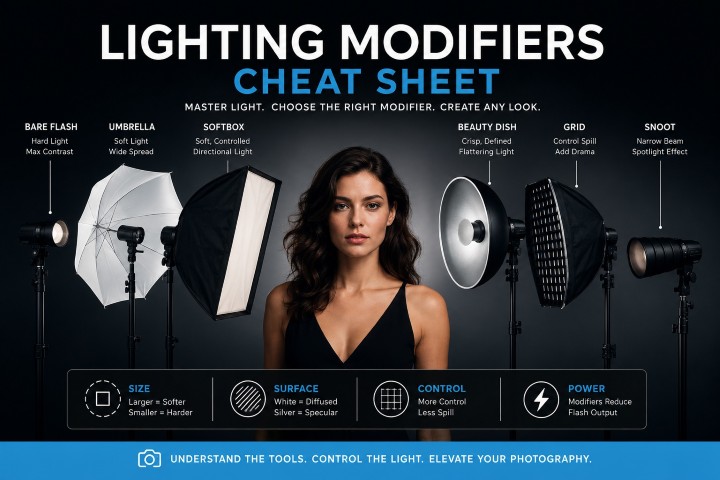
The Ultimate Guide to Flash Lighting Modifiers for Photographers
Photography lighting modifiers are the secret sauce behind cinematic portraits, dramatic fashion campaigns, polished commercial images, and professional wedding photography. Without modifiers, flash lighting often looks harsh, flat, and amateurish. With the right modifier? Your lighting suddenly gains depth, softness, control, and emotion.
The truth is simple: photographers who understand light modifiers consistently create better images than photographers who simply buy expensive gear.
In this guide, we’ll break down how lighting modifiers actually work, why some create soft light while others produce dramatic contrast, and how professionals select the perfect modifier for every shoot.
Understanding the Three Core Principles of Light Modifiers
Every lighting modifier can be understood through three core variables:
- Relative light source size
- Surface reflectivity
- Light spill control
Master these three principles and every modifier instantly becomes predictable instead of confusing.
Relative Light Source Size
Here’s the biggest misconception in photography lighting:
Softness does NOT come from diffusion fabric.
Softness comes from the apparent size of the light source relative to the subject.
A larger light source creates:
- Smooth skin rendering
- Gradual shadow transitions
- Softer facial contours
- Reduced texture contrast
A smaller light source creates:
- Sharp-edged shadows
- Increased texture visibility
- Stronger contrast
- More dramatic facial structure
Think of light like paintbrushes. A tiny brush creates detailed, sharp strokes. A giant brush blends everything together smoothly.
Surface Reflectivity
Not all soft light looks the same.
Some modifiers produce matte, creamy light while others create glossy, contrast-heavy highlights.
That difference comes from reflectivity.
White surfaces scatter light more evenly and reduce specular highlights. Silver surfaces increase brightness, contrast, and texture visibility.
This is why a silver umbrella feels punchier than a white softbox even when both are technically “soft.”
Light Spill Control
Some modifiers throw light everywhere. Others direct it with sniper-like precision.
Broad-spill modifiers are fantastic for fast-paced photography like weddings and events. Controlled modifiers are essential for cinematic portraits and commercial work.
If you’ve ever wondered why some portraits look clean and dimensional while others feel flat and washed out, spill control is often the reason.
Large Light Sources Create Soft Light
Softness is all about apparent size.
A giant octabox placed close to the subject wraps light beautifully around the face. Move that same modifier far away and suddenly the light becomes harsher.
That’s because distance changes apparent size.
Visual Example of Soft vs Hard Light
| Light Source | Relative Size | Shadow Edge | Result |
|---|---|---|---|
| Bare flash | Small | Sharp | Hard light |
| Small softbox | Medium | Moderate | Semi-soft light |
| Large octabox | Large | Feathered | Soft light |
| Window light close to subject | Very large | Extremely gradual | Ultra-soft light |
Diffusion alone does not guarantee softness. The source must appear large relative to the subject.
Why Distance Changes Light Quality
A 120cm octabox isn’t magically soft forever.
Move it far enough away and it behaves like a smaller source.
The Rule of Apparent Size
- Closer modifier = softer light
- Distant modifier = harder light
Beauty photographers often place modifiers extremely close to subjects for this exact reason. The closer the light, the smoother the skin transitions become.
Why the Sun Produces Hard Light
This one surprises beginners all the time.
The sun is massive. So why does it produce hard shadows?
Because it’s incredibly far away.
Relative to your subject, the sun behaves like a tiny point source.
Clouds soften sunlight because they become the new, much larger light source.
Once you understand apparent size, outdoor lighting suddenly makes perfect sense.
Diffused Light vs Specular Light
Softness and specularity are completely different characteristics.
A light can be soft and glossy at the same time.
Diffused Light
Diffused light scatters through translucent material.
Characteristics include:
- Matte skin rendering
- Lower contrast
- Smooth tonal transitions
- Reduced shine
Common diffused modifiers:
- Softboxes
- White umbrellas
- Diffusion panels
- Lantern modifiers
This style works beautifully for corporate headshots, newborn photography, and clean portraiture.
Specular Light
Specular light reflects directly from reflective surfaces.
Characteristics include:
- Strong highlights
- Increased texture visibility
- Higher contrast
- Glossier skin appearance
Common specular modifiers:
- Silver umbrellas
- Beauty dishes
- Reflectors
- Metal reflectors
Specular light is popular in fashion and fitness photography because it enhances muscle definition and facial structure.
Light Spill and Directional Control
Some modifiers spread light everywhere while others tightly shape it.
This dramatically affects image depth and mood.
Broad Spill Lighting Tools
These modifiers spread light widely:
- Shoot-through umbrellas
- Dome diffusers
- Bare flash
Advantages:
- Fast setup
- Broad coverage
- Great for events
Disadvantages:
- Background contamination
- Reduced contrast
- Less precision
Wedding photographers often prioritize speed over precision, making umbrellas and bounce flash extremely practical.
Precision Lighting Tools
These modifiers offer controlled directionality:
- Softboxes
- Grids
- Snoots
- Strip boxes
Advantages:
- Subject isolation
- Cleaner backgrounds
- Cinematic contrast
- Better control
Controlled light is what gives professional studio portraits their polished look.
Flash Power Loss Explained
Every modifier reduces flash efficiency.
That’s because diffusion and reflection absorb light.
Typical Flash Power Loss
| Modifier | Approximate Power Loss |
|---|---|
| Bare flash | 0 stops |
| Umbrella | 1–2 stops |
| Softbox | 1.5–2.5 stops |
| Grid | 0.5–1 stop |
| Double diffusion softbox | 2–3 stops |
This becomes critically important outdoors when balancing flash against sunlight.
If your modifier eats too much light, your flash may struggle at smaller apertures.
Umbrellas


Umbrellas remain one of the most affordable and versatile lighting tools available.
Shoot-Through Umbrellas
Light passes directly through translucent fabric.
Benefits include:
- Very soft output
- Broad spread
- Fast setup
Best for:
- Beginner studios
- Group portraits
- Indoor photography
The downside? Spill control is minimal.
Reflective Umbrellas
The flash bounces into the umbrella interior before reflecting outward.
Silver interiors increase:
- Brightness
- Specularity
- Contrast
White interiors soften contrast slightly and create a gentler look.
Softboxes

Softboxes dominate professional studios because they combine softness with precision.
Unlike umbrellas, softboxes contain spill and project light forward.
Octaboxes
Octaboxes create round catchlights and smooth falloff.
Perfect for:
- Beauty photography
- Fashion editorials
- Portrait work
They produce natural-looking facial illumination that flatters skin beautifully.
Rectangular Softboxes
These are the workhorses of commercial photography.
Ideal for:
- Corporate headshots
- Product photography
- Half-body portraits
Their rectangular shape mimics window light effectively.
Strip Boxes
Tall and narrow, strip boxes excel at:
- Rim lighting
- Athletic portraits
- Edge highlights
They’re frequently used in fitness photography to emphasize body contours.
Beauty Dishes


Beauty dishes create a fascinating blend of softness and contrast.
The central deflector plate redirects light outward, producing:
- Crisp facial definition
- Smooth gradients
- Controlled highlights
Fashion photographers love beauty dishes because they create dimensional skin without looking overly soft.
White vs Silver Beauty Dishes
| Type | Result |
|---|---|
| White | Softer and smoother |
| Silver | Punchier and more specular |
Silver dishes enhance texture and drama. White dishes are more forgiving on skin.
Grids and Snoots


Grids narrow beam spread and prevent unwanted spill.
They increase:
- Subject isolation
- Contrast
- Directionality
- Background darkness
Grid Beam Angles
| Grid Type | Spread |
|---|---|
| 10° | Very narrow |
| 20° | Moderate |
| 40° | Broad control |
Snoots go even further by creating concentrated spotlight effects.
They’re ideal for:
- Hair lights
- Rim lights
- Product highlights
- Theatrical portraits
Reflectors


Reflectors are one of the most powerful low-cost tools in photography.
They can function as:
- Fill light
- Rim light
- Main light
- Negative fill
Reflector Surface Types
| Surface | Result |
|---|---|
| White | Soft neutral fill |
| Silver | Bright specular fill |
| Gold | Warm tones |
| Black | Negative fill |
| Translucent | Diffusion |
A black reflector absorbs light and increases contrast — a trick many cinematic portrait photographers use constantly.
Ring Flash


Ring flashes produce shadowless frontal lighting with distinctive halo shadows.
Characteristics include:
- Flat illumination
- Uniform exposure
- Editorial aesthetics
Best for:
- Fashion campaigns
- Beauty photography
- Macro photography
Love it or hate it, ring flash lighting instantly grabs attention.
Dome Diffusers
Dome diffusers scatter light in all directions.
They work best when:
- Ceilings are low
- Walls are neutral-colored
- Bounce surfaces are nearby
This makes them ideal for:
- Weddings
- Events
- Run-and-gun photography
In large outdoor spaces, however, dome diffusers become far less effective because there’s nothing nearby to bounce light from.
Flash Gels


Flash gels alter color temperature and mood.
Corrective Gels
Used to match ambient lighting conditions.
| Gel | Purpose |
|---|---|
| CTO | Matches tungsten |
| CTB | Matches daylight |
| Plus Green | Matches fluorescent |
Corrective gels help maintain consistent white balance across mixed lighting environments.
Creative Gels
Creative uses include:
- Cinematic color contrast
- Neon aesthetics
- Background separation
- Fashion concepts
Colored gels instantly transform ordinary portraits into visually striking images.
The Best Modifier for Each Photography Genre
| Photography Type | Recommended Modifier |
|---|---|
| Weddings | Dome diffuser + bounce |
| Beauty | Beauty dish |
| Fashion | Octabox |
| Fitness | Gridded beauty dish |
| Corporate headshots | Large softbox |
| Product photography | Strip boxes |
| Environmental portraits | Umbrella or octabox |
| Dramatic portraits | Grid + strip box |
There’s no universally “best” modifier. The right tool depends entirely on the mood and workflow you need.
Combining Modifiers Like a Professional
Professional lighting rarely relies on a single modifier.
The magic often comes from combinations.
Grid + Softbox
Creates:
- Soft light
- Controlled spill
- Cinematic directionality
Beauty Dish + Grid
Creates:
- Fashion contrast
- Controlled highlights
- Strong subject isolation
Umbrella + Diffusion Panel
Creates:
- Extremely broad soft light
- Natural portrait rendering
- Smooth transitions
Layering modifiers gives photographers deeper control over light quality.
Common Lighting Modifier Mistakes
Buying Gear Before Understanding Light
Many photographers collect modifiers without understanding:
- Apparent size
- Beam spread
- Specularity
- Falloff behavior
Knowledge matters more than quantity.
Using Softboxes Too Far Away
A distant softbox behaves like a hard light source.
Placement matters more than price.
Ignoring Background Spill
Uncontrolled spill reduces depth and contrast.
Directional modifiers instantly improve image separation.
Building a Professional Lighting Kit
Beginner Setup
- 1 umbrella
- 1 reflector
- 1 speedlight
Simple, affordable, and highly educational.
Intermediate Setup
- Octabox
- Strip box
- Grid kit
- Reflector set
This setup unlocks advanced portrait lighting possibilities.
Professional Studio Setup
- Multiple strobes
- Large octabox
- Beauty dish
- Strip boxes
- V-flats
- Flags and grids
- Color gels
At this level, lighting becomes fully intentional and repeatable.
Final Thoughts
Every lighting modifier ultimately controls one or more of these characteristics:
- Softness
- Contrast
- Directionality
- Spill
- Specularity
- Coverage
Professional photographers are not simply buying expensive gear. They’re shaping light deliberately.
Once you understand how modifier size, surface, and spill interact, lighting stops feeling random. Suddenly, every modifier becomes predictable, repeatable, and creative.
That’s the real difference between guessing and mastering light.
FAQs
1. What is the best lighting modifier for beginners?
Umbrellas are usually the best starting point because they’re affordable, lightweight, and easy to use.
2. Why do professional photographers prefer softboxes?
Softboxes offer better spill control, cleaner backgrounds, and more consistent directional lighting compared to umbrellas.
3. Are beauty dishes good for portraits?
Absolutely. Beauty dishes create flattering contrast and excellent facial definition, especially for fashion and beauty work.
4. What modifier creates the softest light?
A very large modifier placed close to the subject creates the softest light. Large octaboxes and diffusion panels are excellent examples.
5. Do grids make light harder?
Not exactly. Grids primarily control spill and directionality. However, the increased contrast can make light appear more dramatic.
About the Author: Jarno S. – Kuvaajankulma
Jarno S. is a professional photographer based in Lappeenranta, Finland, and the founder of Kuvaajankulma. With more than 11 years of experience, he captures everything from emotional lakeside weddings by Saimaa to polished corporate portraits and relaxed lifestyle sessions.
His work focuses on genuine emotion, timeless storytelling, and creating a calm, comfortable atmosphere where people can simply be themselves. Whether documenting a family’s most meaningful moments or helping a business build a trustworthy visual identity, Jarno’s goal is always the same: images that feel real and last.
Explore his portfolio or book a session: www.kuvaajankulma.com
Photographer Jarno.S Kuvaajankulma Lappeenranta



Vastaa